

Task:
Michel Foucault founded the concept of "heterotopia" in 1967. He used this term to describe spaces that differ from other everyday spaces in terms of their role and rules. This can occur, for example, through an altered perception of time: Cemeteries symbolise eternity, whereas nightclubs seem fast and fleeting. The aim of the project is to capture the special characteristics of heterotopias visually and creatively and to present them in an artistic format.
Idea:
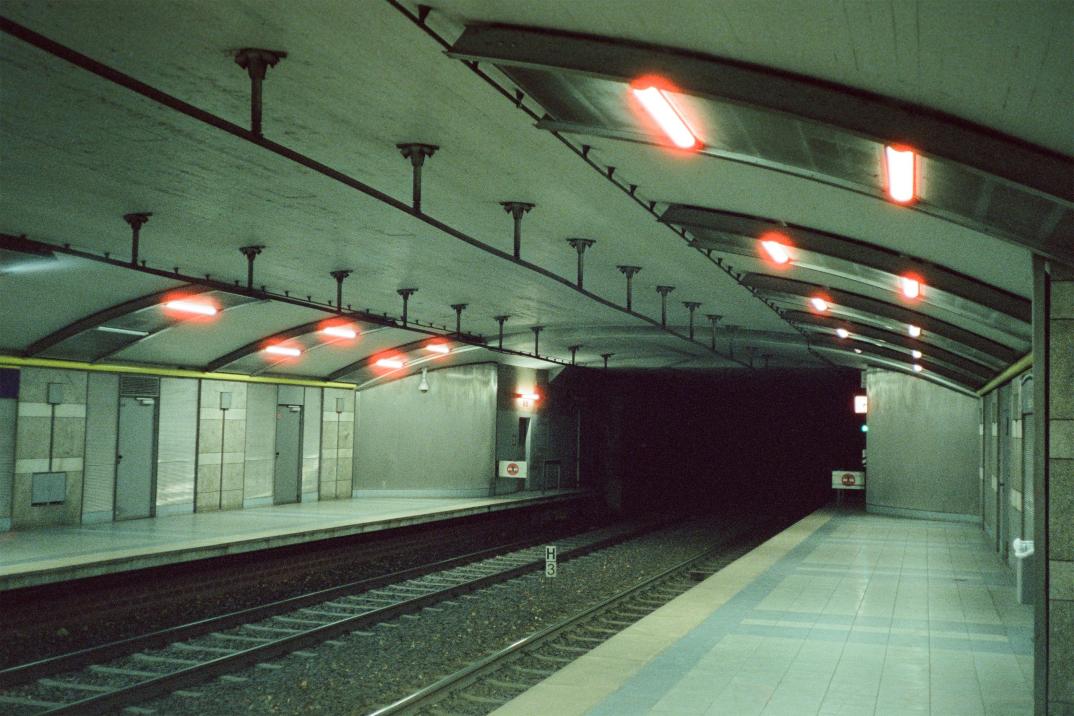
Underground stations in Hamburg, Hanover, Berlin and Vienna can be viewed as heterotopias. The idea is to document the spatial aesthetics, functionality and dynamics of these places using analogue photography and book design. The aim is to reflect and visualise their significance as counter-spaces to everyday life. What does it take to capture abstract concepts in design aesthetics?
Solution:
The analogue photographs were compiled in four photo books, each focusing on one city. Uniform design elements such as layout, visual language and symbolism link the books, while the images show the diversity of the stations and environments. One person was portrayed in each book to strengthen the personal connection. A specially produced steel slipcase artistically bundles the books and emphasises the concept.

